Skip to content
walkwalk.
Plantage: the green quarter and its long memory
leafyheritage

Plantage: the green quarter and its long memory

A botanical garden, the Auschwitz mirror, and zoo flamingos seen across a canal.

Photo: Jvhertum / Wikimedia Commons, Public domain

Distance

3 km

Time

~ 75 min

Difficulty

Easy

End

Artis / Plantage (tram 14)

Best at

morning

Right now
19°C· Partly cloudy

Open in Maps for turn-by-turn, or take it offline as GPX.

The Plantage is where Amsterdam keeps its trees and its hardest history in the same few streets, and the only honest way to walk it is to let both in. Three kilometres, mostly green, with a weight running under the leaves the whole way.

Start at Waterlooplein and walk east into the Hortus Botanicus, a working garden since 1638 — go in for the butterfly house, or read it from the gate and move on. Across the road is Wertheimpark, the oldest park in the city, and Jan Wolkers' Nooit meer Auschwitz: broken mirrors in the grass that hand you back a cracked sky. Don't rush it. From there the Esnoga — the 1675 Portuguese Synagogue — and the Hollandsche Schouwburg, a theatre made into a deportation point and now a memorial, sit a few doors apart on Plantage Middenlaan.

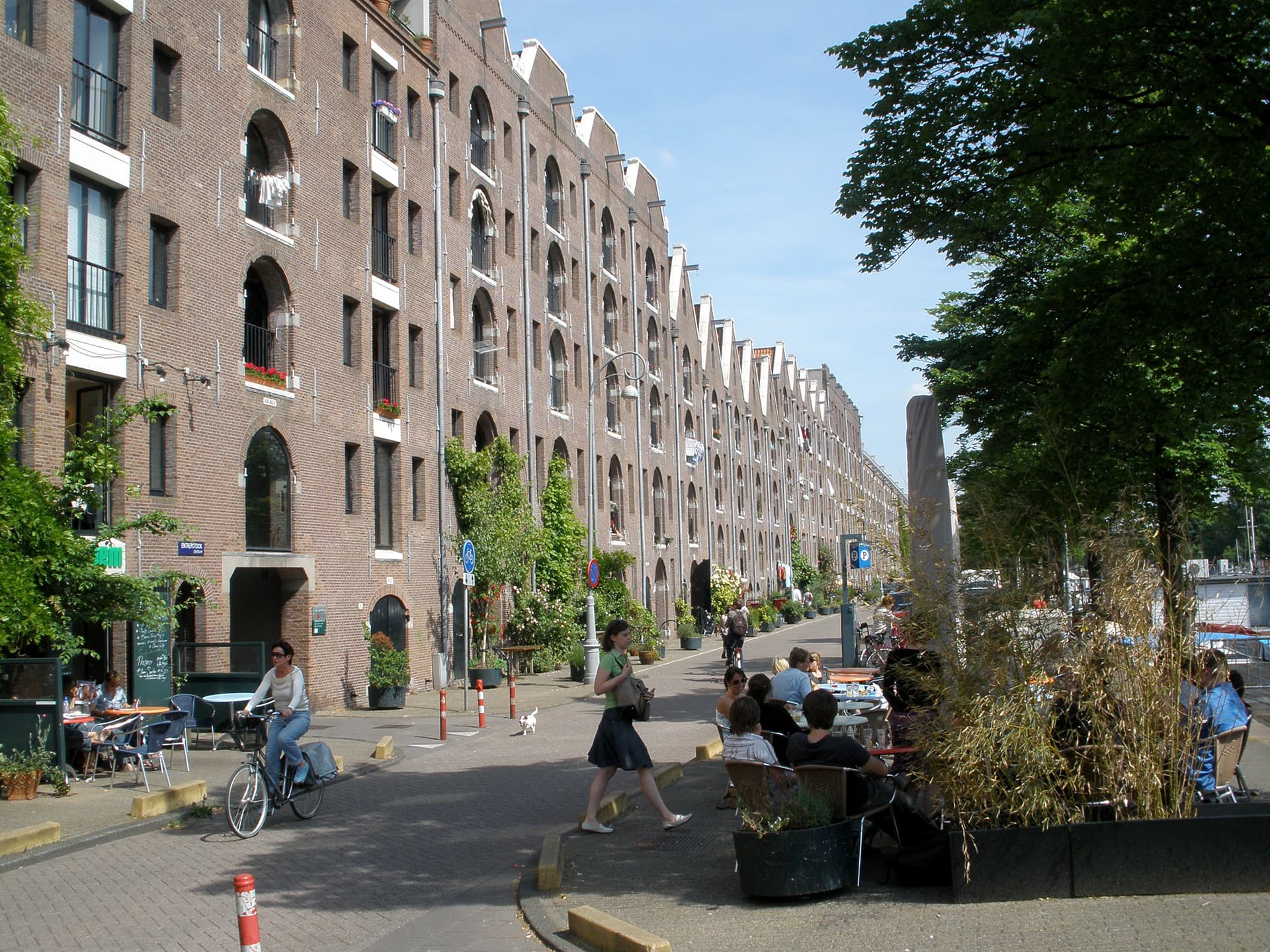
Then the mood lifts. Cut down to the Entrepotdok, a long terrace of converted trade warehouses, and look across the water: the flamingos of Artis are standing right there, in the middle of the city. Coffee on the quay, and tram 14 home.

The route

On the map.

Elevation

24 m·30 m·210 m ASL

Stops along the way

Things to notice.

  1. 01
    1

    Waterlooplein

    Start where the old Jewish quarter began, before the war emptied it. Walk east along the water toward the Plantage; the change from city to garden happens in a few hundred metres.

  2. 02
    2

    Hortus Botanicus

    One of the oldest botanical gardens anywhere, laid out in 1638 to grow the medicinal plants the city's apothecaries needed. Go in for the butterfly house and the giant water lily, or just read the garden from the gate; the *Plantage* takes its name from grounds like this one.

  3. 03
    3

    Wertheimpark and the Auschwitz monument

    The city's oldest public park, and Jan Wolkers' *Nooit meer Auschwitz* — broken mirrors set in the grass so the sky overhead comes back to you cracked. An urn of ashes from the camp is buried beneath. Stand a moment; that's the visit.

  4. 04
    4

    Portuguese Synagogue

    Elias Bouman's *Esnoga*, finished in 1675 and still lit by candle, has outlasted everything around it. Visiting hours and the museum ticket vary by season — check before you count on going in; the brick bulk from the square is its own statement.

  5. 05
    5

    Hollandsche Schouwburg

    A theatre the Nazis turned into a deportation point; tens of thousands of the city's Jews passed through here on their way east. It's a memorial now, quiet and free. The façade is all that's left of the auditorium, and that's deliberate.

  6. 06
    6

    Entrepotdok

    Eighty-odd warehouses of the old Dutch East India trade, named for the goods they once held, now flats facing the water. Across the canal is *Artis*, the zoo — the flamingos stand in plain sight from the quay. End with a coffee here; the tram is a short walk back.

Good to know

Before you go.

How long is the Plantage: the green quarter and its long memory walk?
About 3 km — roughly 75 minutes at an unhurried pace, plus however long you linger.
Where does it start and end?
It starts at Waterlooplein metro (M51/M53/M54) and ends at Artis / Plantage (tram 14).
Is it free?
Yes. It's a self-guided route — free to follow, with no guide to book and nothing to pay.
When is it best?
It's best in the morning.