Skip to content
walkwalk.
Canal Saint-Martin: the locks and the iron bridges
canalpocket

Canal Saint-Martin: the locks and the iron bridges

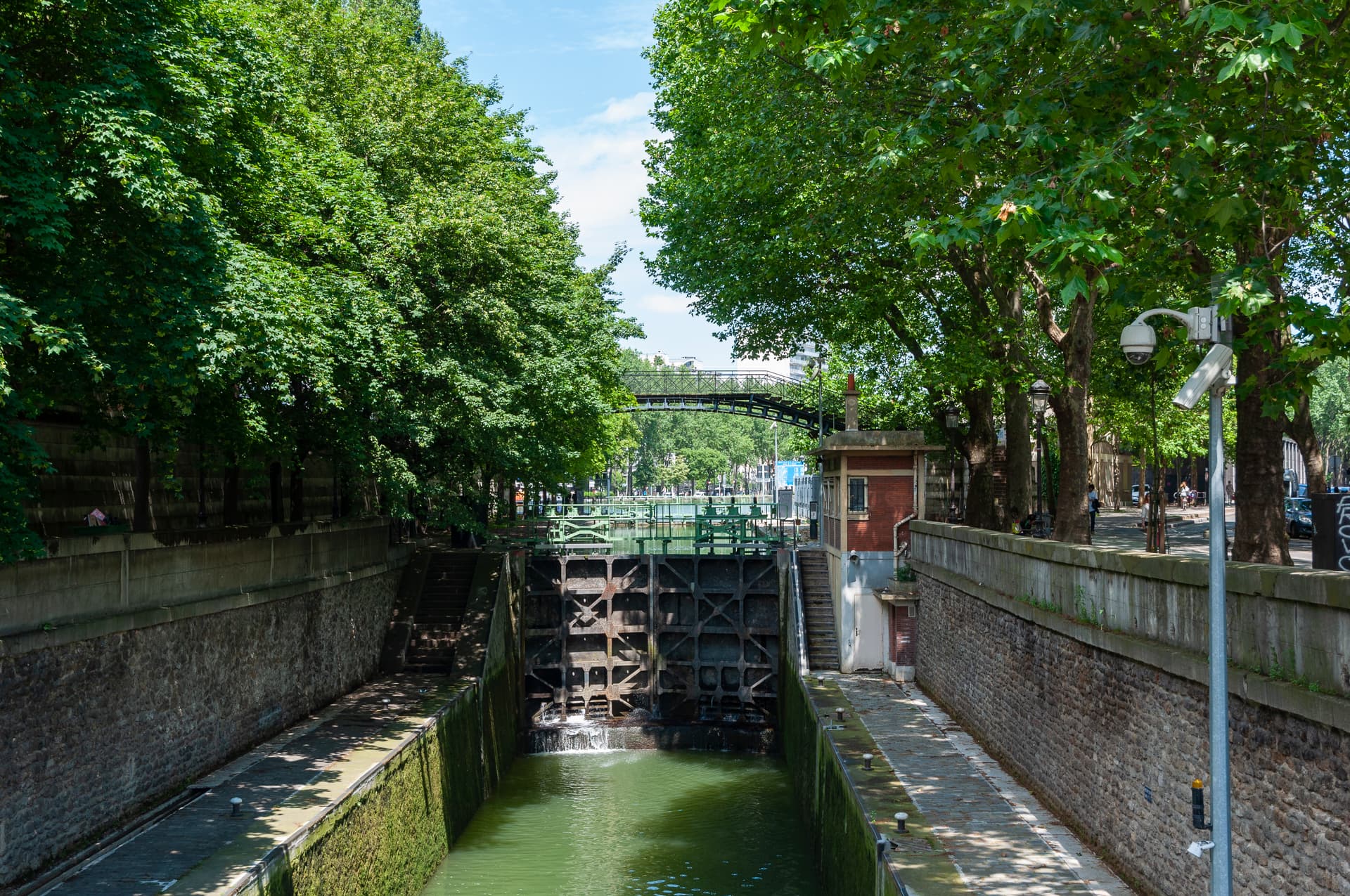
The double locks, the arched footbridges, and the canal that gets wider all the way to the Rotonde.

Photo: André Alliot / Wikimedia Commons, CC0

Drafted by Claude — the editor hasn’t walked this one yet. We’ll update this notice once it’s been verified on the ground.

Distance

3.5 km

Time

~ 80 min

Difficulty

Moderate

End

Jaurès (M2/M5/M7bis)

Best at

afternoon

Right now
35°C· Mostly clear

Open in Maps for turn-by-turn, or take it offline as GPX.

The Canal Saint-Martin is the tenth arrondissement's open secret in plain sight: a working waterway with double locks, swing bridges and arched iron footbridges, threading north from the quais to the wide Bassin de la Villette. Plane trees lean over the water; the péniches (canal barges) still pass through the locks.

Three and a half kilometres, gently uphill in spirit if not in fact. Start at Jacques Bonsergent and drop to the Quai de Valmy — walk the bank, not the boulevard, for the independent shops. Past the Hôtel du Nord facade, where Arletty never actually filmed, then the Écluses des Récollets: wait for a barge if one's coming, because watching the gates work is the point of the canal.

The footbridges are the other point. Climb the Passerelle de la Grange-aux-Belles for the long view down the water. North of here the canal goes underground and surfaces again as the Bassin de la Villette, the widest water in the city — café terraces, a cinema, swimmers in summer.

End at the Rotonde de Ledoux, the 1788 customs pavilion, with Jaurès station at its foot.

The route

On the map.

Elevation

117 m·107 m·3861 m ASL

Stops along the way

Things to notice.

  1. 01
    1

    Quai de Valmy

    Drop down to the water from Jacques Bonsergent and turn north along the *quai* (canal embankment). The independent shops on this side — homeware, secondhand books, small fashion — are the reason to walk the bank rather than the boulevard.

  2. 02
    2

    Hôtel du Nord

    The 1885 facade made famous by Marcel Carné's 1938 film, even though the film was shot in a studio. Sit on the canal edge opposite if the stone steps are dry; it's the best people-watching on the whole stretch.

  3. 03
    3

    Écluses des Récollets

    The double lock where the *péniches* (canal barges) rise and fall. Wait for one to come through if you have ten minutes — the gates, the rush of water, the slow lift, all unchanged since the 1820s.

  4. 04
    4

    Passerelle de la Grange-aux-Belles

    One of the arched iron footbridges that arc over the canal. Stand at the top for the view down the water to the next lock; this is the shot everyone takes, and rightly.

  5. 05
    5

    Bassin de la Villette

    The canal opens into the widest stretch of water in Paris. Cafés and a cinema line both quays; in summer there's swimming and pedalos. Cross to whichever bank has the sun.

  6. 06
    6

    Rotonde de la Villette

    Ledoux's 1788 customs pavilion at the head of the bassin — one of the few survivors of the wall that once ringed Paris to tax goods coming in. Now a restaurant under the metro arches. Jaurès station is right here.