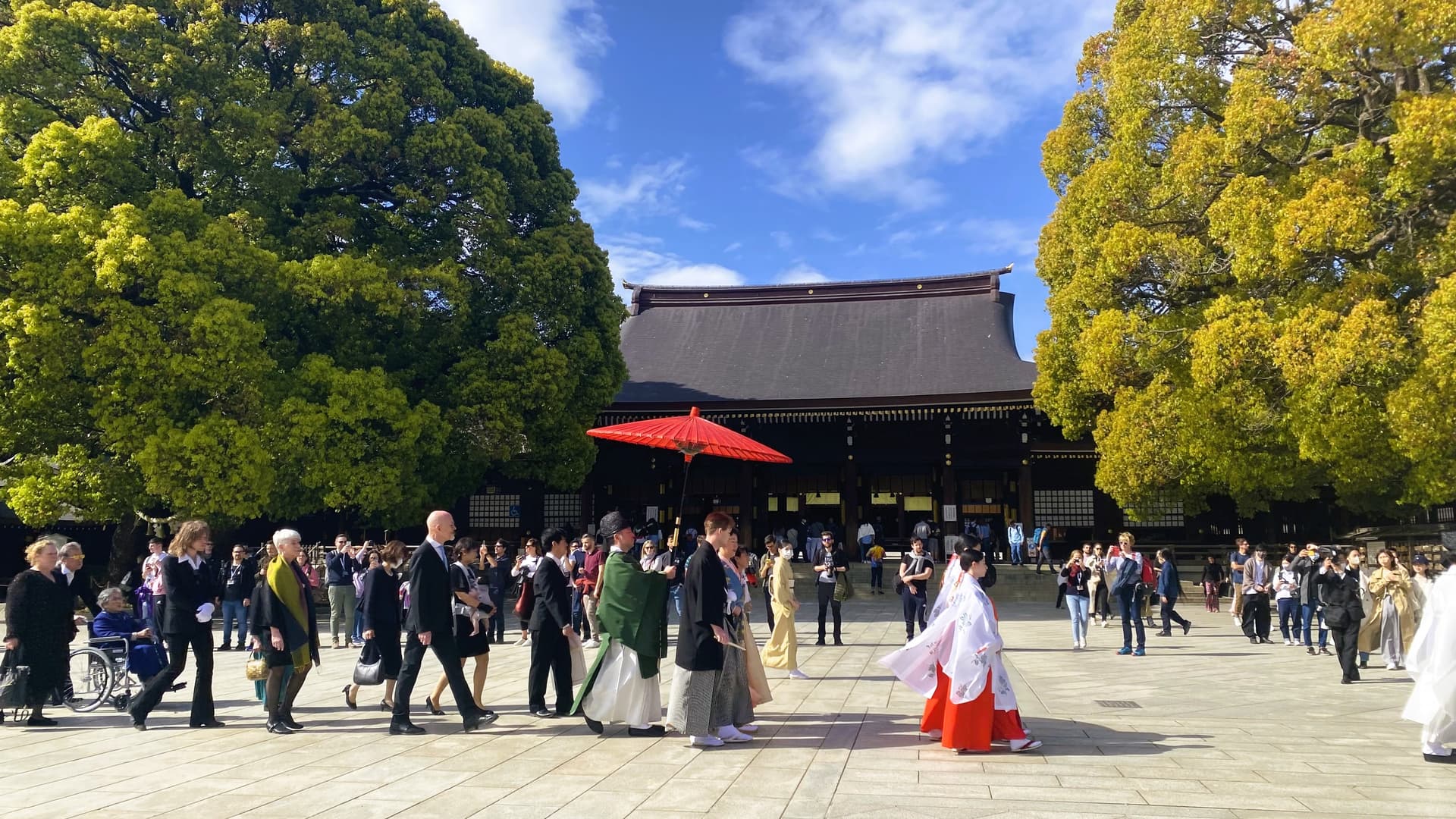
Meiji Jingu sits inside a forest that someone planted on purpose. A hundred thousand trees, donated from across Japan in 1920 and arranged so that within a century it would look wild — which it now does, completely, a few hundred metres from the busiest crossing on earth.
Three and a half kilometres, best on a Sunday morning. Come out of Harajuku, cross the bridge, and walk through the great torii (shrine gate) where the city drops away. The gravel approach is long on purpose; the sake-barrel wall and the wine barrels opposite mark the halfway point. The main shrine is plain, dark wood, rebuilt after the war — read the ema plaques by the courtyard and you'll see who travels here.
The inner garden, Gyoen, costs extra and rewards it, most of all in mid-June when the irises are out. Then west, out of the trees and into Yoyogi park, where on a Sunday the drummers and the rockabilly dancers have claimed the ground by the fountain for forty years. The forest, then the noise. End at Yoyogi-koen on the Chiyoda line.

