walkwalk.
Grundtvigs Kirke and Bispebjerg
architectureheritage

Grundtvigs Kirke and Bispebjerg

Jensen-Klint's 1940 expressionist brick church and the workers' housing he laid out around it — one of Europe's most distinctive brick buildings.

Drafted by Claude — the editor hasn’t walked this one yet. We’ll update this notice once it’s been verified on the ground.

Distance

3 km

Time

~ 90 min

Start

Bispebjerg S-tog (F-line)

End

Bispebjerg S-tog (F-line)

Best at

afternoon

Right now
23°C· Partly cloudy

Open in Maps for turn-by-turn, or take it offline as GPX.

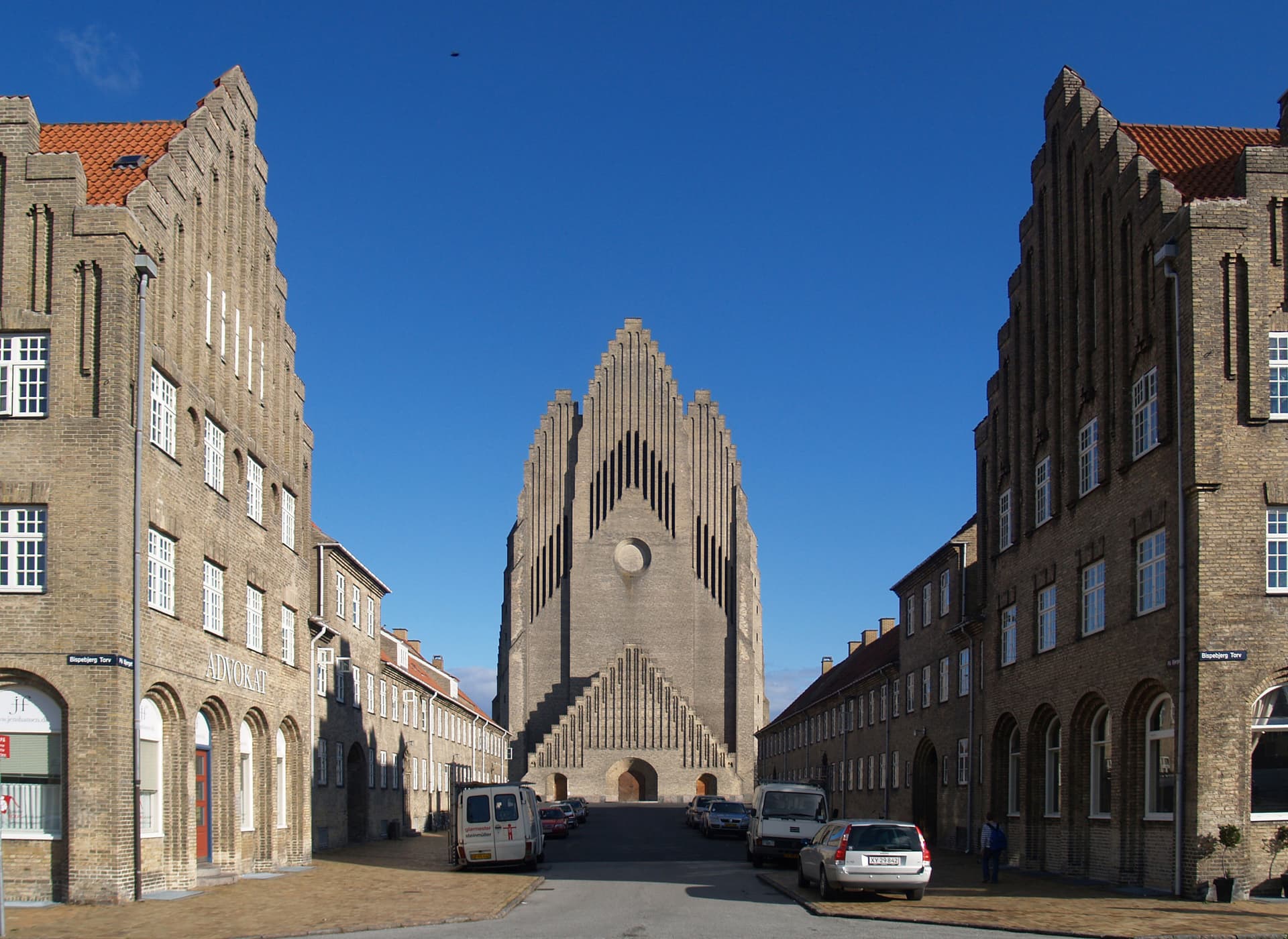
Grundtvigs Kirke is the building — Peder Vilhelm Jensen-Klint's expressionist brick church, started 1921 and finished by his son Kaare Klint in 1940. Six million bricks, an organ-pipe vertical facade unlike anything else, dedicated to the 19th-c Danish theologian and poet N.F.S. Grundtvig. Around it, the På Bjerget housing the same architects designed as a single 1920s workers' Gesamtkunstwerk.

Three kilometres on a small Bispebjerg hill, ninety minutes including the church. Bispebjerg S-tog (F-line) is the entry; walk north up Frederiksborgvej and the church silhouette appears within ten minutes — the vertical brick facade reading like a gigantic pipe organ from a distance.

The exterior is the first half of the visit. Walk the perimeter; the church's strict verticality reads differently from each side. Inside, the vertical bricks continue up the columns to the vaulted ceiling — vast, restrained, the lighting almost entirely from clerestory windows. Free entry; quiet most weekday afternoons.

På Bjerget (literally On the Mountain) is the housing around the church, laid out by Jensen-Klint to match the church's brick vocabulary. Bispebjerg Kirkegård sits south — wooded, residential in feel, the cemetery's quiet matching the church's.
The route

On the map.

Stops along the way

Things to notice.

  1. 01
    1

    Bispebjerg S-tog

    F-line S-tog stop. Walk north up *Frederiksborgvej* for ten minutes; the church silhouette appears as you climb the gentle hill.

  2. 02
    2

    Approach to Grundtvigs Kirke

    *På Bjerget* — *On the Mountain* — is the name of the small hill the church sits on. The approach is the architecture; the church reads vertically against the sky from blocks away.

  3. 03
    3

    Grundtvigs Kirke exterior

    Peder Vilhelm Jensen-Klint's expressionist brick church, started 1921 and completed 1940 (Klint died in 1930; his son Kaare Klint finished the work). Six million bricks. The vertical organ-pipe facade is the photograph — austere, geometric, distinct from any other church in Europe. Walk the perimeter.

  4. 04
    4

    Grundtvigs Kirke interior

    The vertical bricks continue up the columns to the vaulted ceiling — vast, restrained, the lighting almost entirely from clerestory windows. The interior brick is the same yellow-grey hand-made stuff as the exterior. Free entry; quiet most weekday afternoons. Closed Sunday mornings during services.

  5. 05
    5

    På Bjerget housing

    The 1920s workers' housing Jensen-Klint and Kaare Klint laid out to surround the church. Same brick vocabulary, scaled to a domestic register — terraced houses, courtyards, small front gardens. Walk the surrounding streets; the architecture is unified across the neighbourhood.

  6. 06
    6

    Bispebjerg Kirkegård

    The cemetery just south. Less famous than *Assistens*, more wooded, fewer pilgrimage graves. The cemetery functions as a park as much as a graveyard. Walk a stretch on the way back to the S-tog.