walkwalk.
Rosenborg and Kongens Have: castle in the garden
parklandheritage

Rosenborg and Kongens Have: castle in the garden

Christian IV's Renaissance castle in the middle of Copenhagen's oldest park, with the crown jewels in the basement.

Drafted by Claude — the editor hasn’t walked this one yet. We’ll update this notice once it’s been verified on the ground.

Distance

2.5 km

Time

~ 75 min

Start

Nørreport (M1/M2/M3 + S-tog)

End

Nørreport (M1/M2/M3 + S-tog)

Best at

afternoon

Right now
23°C· Partly cloudy

Open in Maps for turn-by-turn, or take it offline as GPX.

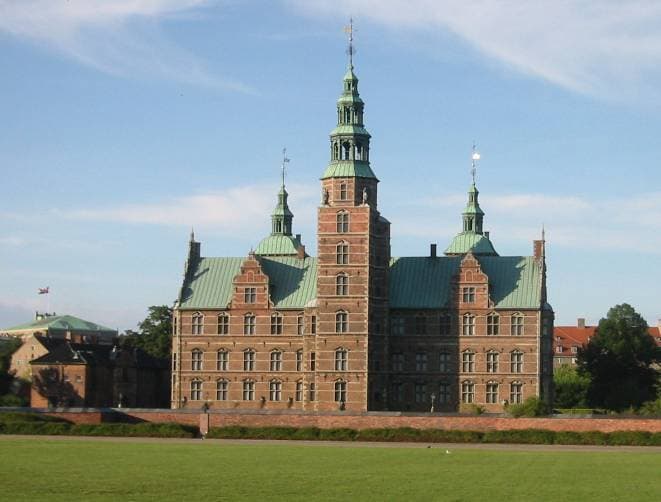
Rosenborg is the Renaissance castle Christian IV built as a summer retreat in 1606, and never properly left. Red brick, copper spires, the Dutch Renaissance style the Danish kings imported when they wanted something newer than what the previous king had. It sits in the middle of Kongens Have, Copenhagen's oldest park, free and busy on any warm afternoon.

Two and a half kilometres, seventy-five minutes if you do the basement crown jewels. Start at Nørreport — the city's busiest transit knot, where M1, M2, M3 and the S-tog all meet. The park's main gate is two minutes east on Gothersgade. Walk east through the lime avenues; the lines are Christian IV's even if the trees themselves have been replanted.

The castle is at the centre. Pay to go in; the audience halls upstairs are the architectural payoff, the Skatkammeret basement is where the crown jewels and the Coronation Throne are. The Herkulespavillonen is a small 1773 folly in the southern grounds. North across Øster Voldgade, the university's Botanisk Have opens onto the old rampart land — the Palmehus (1874) is the small Danish version of Kew's. Back to Nørreport via the boating lake.

The route

On the map.

Stops along the way

Things to notice.

  1. 01
    1

    Nørreport

    Copenhagen's busiest transit knot — M1, M2, M3 Cityringen, plus the regional S-tog. The park's main gate is two minutes east on *Gothersgade*; you'll cross the bike traffic before you see the trees.

  2. 02
    2

    Kongens Have main entrance

    The Gothersgade gate into Copenhagen's oldest royal garden, laid out under Christian IV in the early 1600s. The lime trees were planted in the 1660s and have been replanted since, but the avenues are the king's. Locals lie on the lawn from May to September.

  3. 03
    3

    Rosenborg Slot

    Christian IV's 1606 Renaissance summer castle, expanded twice during his reign and never properly left. Pay to go inside — the audience halls upstairs (the Knights' Hall with its silver lions, the Long Hall with the tapestries) are the architectural payoff; the *Skatkammeret* basement is where the Danish crown jewels and the Coronation Throne live. Closed Tuesdays in winter.

  4. 04
    4

    Hercules Pavilion (Herkulespavillonen)

    A small 1773 garden folly in the southern grounds, named for the marble Hercules statue inside. The Renaissance garden originally extended much further south; this pavilion marks where it once ended. Easy to miss between the lime alleys.

  5. 05
    5

    Botanisk Have + the Palm House

    Across *Øster Voldgade* on the old rampart land. The University of Copenhagen's Botanical Garden, free entry to the grounds. The *Palmehus* (1874) is a smaller, gentler cousin to Kew's Palm House — iron and glass on a domestic scale, open every day. The pond around it is part of the old city moat.

  6. 06
    6

    Back to Nørreport

    The botanical garden's southern exit lands you at *Nørreport*. M3 Cityringen orbits the centre, M1/M2 head north or south, S-tog runs to anywhere in greater Copenhagen.