Skip to content
walkwalk.
Kyoto Station: the atrium and the two Hongan-ji
architecturemonumental

Kyoto Station: the atrium and the two Hongan-ji

A vast steel-and-glass station, two of Japan's largest temple halls, and a borrowed-scenery garden.

Photo: Jakub Hałun / Wikimedia Commons, CC BY 4.0

Drafted by Claude — the editor hasn’t walked this one yet. We’ll update this notice once it’s been verified on the ground.

Distance

3.6 km

Time

~ 90 min

Difficulty

Easy

End

Kyoto Station (JR / Karasuma subway)

Best at

afternoon

Right now
24°C· Mostly clear

Open in Maps for turn-by-turn, or take it offline as GPX.

Kyoto Station is the argument the city had with itself and mostly lost. Hiroshi Hara's 1997 building is a fifteen-storey canyon of steel and glass dropped into a town that had spent twelve centuries keeping its rooflines low — and it is, whatever the purists say, one of the great modern rooms in Japan. This walk pairs it with the two enormous temples that sit just to the north, the old city answering the new.

Start at the foot of the Daikaidan, the great staircase, and ride the escalators to the eleventh-floor Skyway and roof terrace — free, and the best free view in the south, the mountains all around. Then north to Higashi Hongan-ji, whose founder's hall is among the largest wooden buildings on earth; the scale only lands once you're standing on the tatami beneath it.

East to Shosei-en, the walled garden where the traffic vanishes, then west to Nishi Hongan-ji, older and gilded, its Karamon gate carved past the point of restraint. Walk back down Shomen-dori past the incense and altar shops to the station front, weather no object the whole way.
The route

On the map.

Elevation

50 m·74 m·2956 m ASL

Stops along the way

Things to notice.

  1. 01
    1

    Hara's atrium

    Start inside the station Hiroshi Hara finished in 1997 — a fifteen-storey canyon of steel and glass that scandalised a city of low temples when it opened. Stand at the bottom of the *Daikaidan*, the great staircase, and look up; the roof is a single curved sweep over the whole concourse.

  2. 02
    2

    The rooftop Skyway and garden

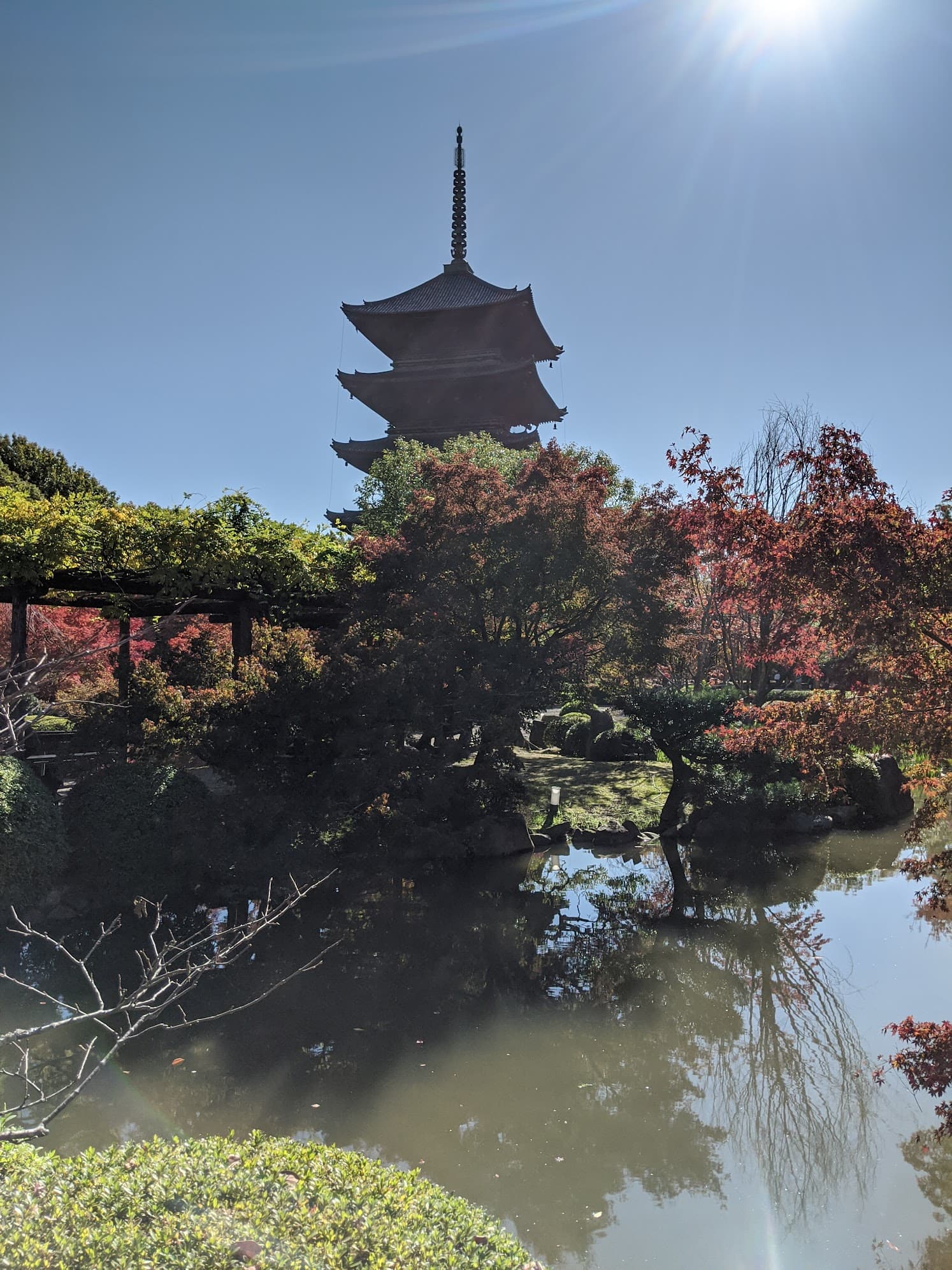
    Escalators climb the east side to the eleventh-floor *Skyway*, a glazed bridge across the void, and out to the *Daikaidan* roof terrace. Free, often empty, and the one place to see the city ringed by its mountains with the pagoda of To-ji to the south-west. Worth the ride even if you go straight back down.

  3. 03
    3

    Higashi Hongan-ji

    North across the broad avenue to the *Higashi* (east) temple of the Jodo Shinshu sect — the *Goeido*, its founder's hall, is one of the largest wooden buildings in the world. Step inside onto the tatami; the scale only registers once you're under the roof. Free, and rarely crowded for its size.

  4. 04
    4

    Shosei-en garden

    The detached garden east of Higashi Hongan-ji, a pond stroll laid out in the 1600s and walled off from the traffic completely. A small donation at the gate. The borrowed view of the Higashiyama hills, the tea pavilions over the water — the quiet heart of the whole walk.

  5. 05
    5

    Nishi Hongan-ji

    West to the rival *Nishi* temple, the older and more decorated of the two, its *Goeido* and *Amidado* halls facing a gravel court. Look for the gingko said to be four hundred years old and the lavish *Karamon* gate around the side, gilded and carved to the point of excess. A World Heritage site, and free.

  6. 06
    6

    Shomen-dori back to the station

    Walk back south down *Shomen-dori*, the old approach lined with Buddhist-supply shops — incense, altar fittings, monks' robes — a trade that has clustered here for centuries. It feeds you back toward the station front, where the walk began and the trains wait.