Skip to content
walkwalk.
To-ji: the tallest pagoda and the temple market
monumentalmarket

To-ji: the tallest pagoda and the temple market

Japan's tallest wooden tower, a temple of esoteric Buddhism, and the great monthly flea market.

Photo: Andrevan / Wikimedia Commons, CC BY-SA 4.0

Drafted by Claude — the editor hasn’t walked this one yet. We’ll update this notice once it’s been verified on the ground.

Distance

3.4 km

Time

~ 85 min

Difficulty

Easy

End

Kyoto Station (JR / Karasuma subway)

Best at

morning

Right now
33°C· Mostly clear

Open in Maps for turn-by-turn, or take it offline as GPX.

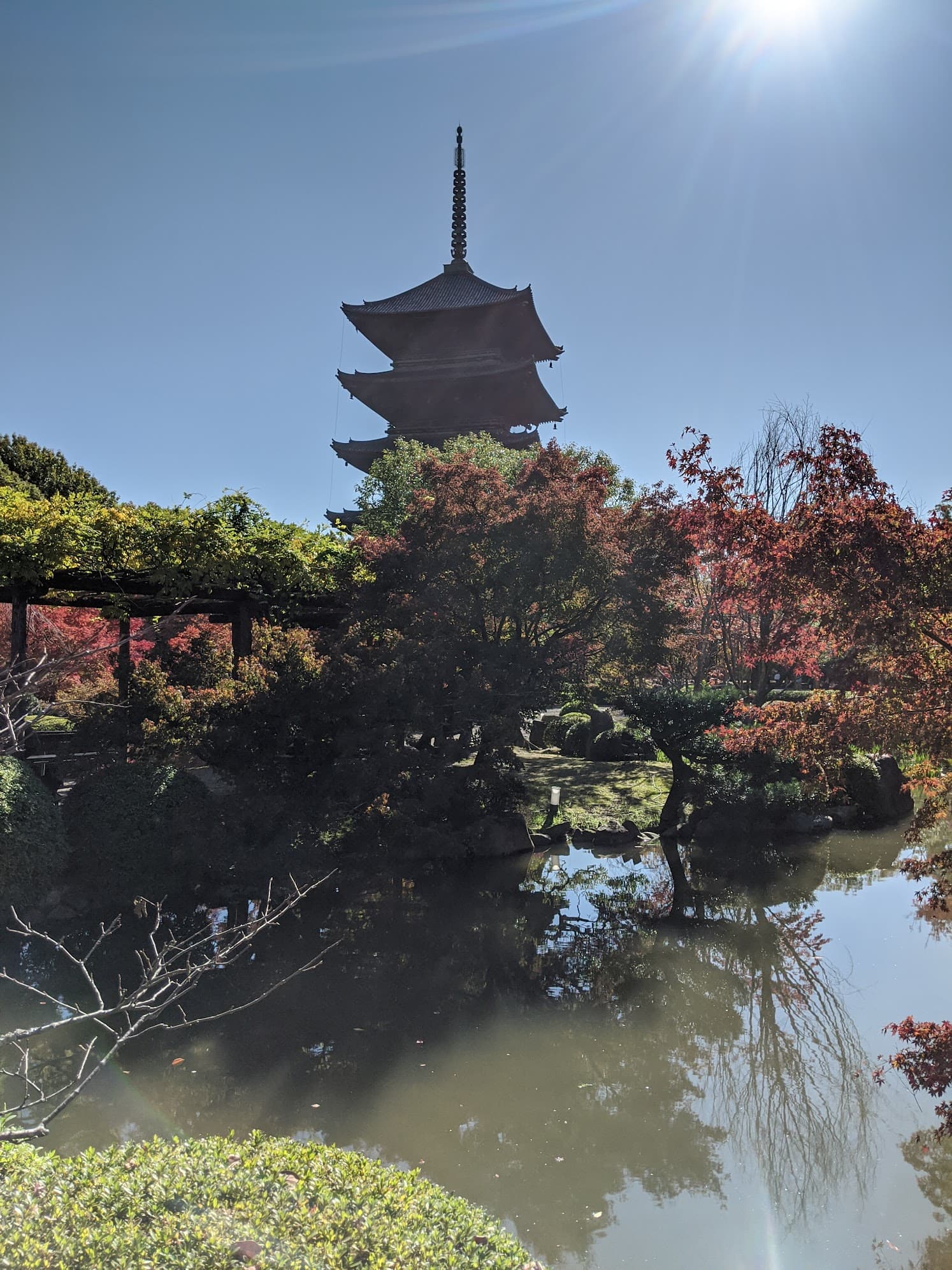
To-ji is the temple you see from the train, and the one Kyoto walk built around a single vertical line. The five-storey pagoda — 55 metres, the tallest wooden tower in the country — has marked the southern edge of the city for twelve hundred years, ever since the new capital granted Kobo Daishi the temple to guard its gate. Three and a half kilometres from the pagoda to the station, an easy morning.

See the pagoda first from across the Hyotan-ike pond, where it doubles in the water. Then the inner precinct: the Kondo and, beyond it, the Kodo (lecture hall) holding Kobo Daishi's three-dimensional mandala of twenty-one statues — a diagram of the cosmos you can walk around. The founder's hall, the Miedo, is free and quieter.

If you come on the 21st, the grounds are a thousand-stall flea market, the Kobo-ichi, held since the saint's death day — antiques, old kimono, food. Any other morning it's empty gravel. Walk east afterward, past the stone marking the vanished Rashomon gate, through the working streets to Kyoto Station.

The route

On the map.

Elevation

27 m·26 m·2228 m ASL

Stops along the way

Things to notice.

  1. 01
    1

    The five-storey pagoda

    Walk up from Toji station and the pagoda is the thing — at 55 metres the tallest wooden tower in Japan, rebuilt for the fifth time in 1644 after lightning kept taking the earlier ones. You see it best from across the *Hyotan-ike* pond, mirrored in the water, the line everyone wants and earns.

  2. 02
    2

    The Kondo and Kodo halls

    *To-ji* is the headquarters of Shingon, the esoteric Buddhism Kobo Daishi brought from China in the ninth century. The *Kodo* (lecture hall) holds his three-dimensional *mandala* — twenty-one statues arranged as a single diagram of the cosmos. Pay the inner-precinct ticket; this is the reason beyond the pagoda.

  3. 03
    3

    Miedo (the founder's hall)

    The hall where Kobo Daishi is said to still reside, served a meal every morning at six. Free to enter, quieter than the ticketed precinct, and the wooden veranda is a good place to sit. The morning ritual is worth timing if you're early enough.

  4. 04
    4

    Kobo-ichi market grounds

    On the 21st of each month the precinct fills with a thousand stalls — antiques, old kimono, tools, plants, street food — the *Kobo-ichi* flea market held since the saint's death day. On any other day this is empty gravel; the market is the whole reason to come on the 21st, and a quiet temple any other morning.

  5. 05
    5

    Rashomon site

    A few minutes east, a small stone in a playground marks where the *Rashomon* once stood — the great southern gate of the ancient capital, the one in the Kurosawa film and the older story. Nothing remains but the marker; stand on it and the scale of the vanished city does the rest.

  6. 06
    6

    The streets toward the station

    Walk east along the old grid toward Kyoto Station, past Higashi Hongan-ji's vast roofs if you bear north. It's an unglamorous stretch of the real working city — bicycle shops, lunch counters — and a fair antidote to the temple. The station front appears at the end.